AI Search
The AEO Checklist for 2026: How to Get Cited by AI
What actually gets a brand named by ChatGPT, Perplexity and AI Overviews, what you can safely skip, and a 90-day plan you can start this week.

Nayana B. SenSEO Manager · Updated · 27 min read
Key takeaways
- Google says optimizing for generative AI search is still SEO, because its AI features are rooted in its core ranking and quality systems. Fix crawling, indexing and content first.
- Brand web mentions correlated with AI Overview visibility at 0.664, against 0.218 for backlinks, in Ahrefs' study of 75,000 brands.
- AI Overviews now appear on most searches in Ahrefs' tracked data: 73.3% of branded and 78.3% of non-branded keywords in September 2026.
- AI referral traffic is tiny, about 0.5% of visits in Similarweb data, and conversion claims vary widely. One study saw it convert worse than organic on 23 of 63 sites. Treat AI like a brand channel.
- Measure with Search Console's Generative AI report, Bing's AI Performance report, a fixed prompt list and a 'How did you hear about us?' question.
The logic behind AEO and GEO is SEO itself, and that's not my hot take. Google's own guide says optimizing for generative AI search is "still SEO", because AI Overviews and AI Mode are rooted in its core Search ranking and quality systems. So when someone asks me, "Why does ChatGPT recommend them and not us?", I start with the basics, not a magic trick.
I get that question a lot. I lead SEO for the English market at Visme, and I track our brand mentions and citations across ChatGPT, AI Overviews, Gemini, Perplexity and Copilot, so this isn't theory for me. It's a Tuesday. This checklist covers the few new rules on top of SEO, what the data says as of November 2026, and what you can safely ignore, based on platform documentation, published research and nearly 10 years in search.
What is AEO, really?
AEO (Answer Engine Optimization) is the work of getting your brand named or cited when people ask AI tools a question. That covers ChatGPT, Perplexity, Gemini, Copilot, Claude, and Google's AI Overviews and AI Mode. GEO (Generative Engine Optimization) is the same job with a different badge, so please don't build two strategies.
The big difference from classic SEO is the prize. In SEO you compete for a position in a list. In AEO there's no list: the AI reads a pile of sources, writes one answer, and decides who gets a name-drop. You're competing for a mention, not a rank.
You'll also hear "ASO" or agentic search optimization, which Semrush uses for the bigger picture: AI agents that don't just answer, but compare and buy things for people. Same foundation, one more layer.
SEO vs. AEO and GEO: what actually changes?
| SEO | AEO and GEO | |
|---|---|---|
| The result | A list of ranked links | One generated answer |
| What people type | Short keywords | Longer, conversational prompts |
| The goal | A higher position | A mention or citation in the answer |
| Your content | People click through to read it | AI summarizes it inside the answer |
| How you score it | Rankings, clicks, traffic | Citations, mentions, share of voice |
That comparison, adapted from Semrush, shows what changes on the surface. Underneath, it's the same machinery for Google: AI Overviews and AI Mode use retrieval-augmented generation (RAG) to pull pages from the Search index with its core ranking systems. If Google can't crawl, index and rank your page, the AI layer has nothing to work with. One caveat: Google is only speaking for Google. ChatGPT and Perplexity use their own systems, which is why the rest of this checklist goes a bit further.
Why does AEO matter in November 2026?
AEO matters because AI answers now sit on top of most searches and they take the clicks. Ahrefs found that an AI Overview cuts the click-through rate of the number one page by 58%. Out of every 100 clicks that page used to get, 58 are gone. And Bain research cited by Semrush found 80% of users answer 40% of their queries without clicking at all.
The newest data is even spicier. Ahrefs studied 232.8 million US desktop search results from July to September 2026 and found AI Overviews on 73.3% of branded keywords in September, hitting 82.91% on September 29. Yes, that means your own brand name. Look at how fast it moved:
Share of keywords showing an AI Overview, US desktop, 2026
Quick reality check on that chart. An earlier Ahrefs study found a much lower figure, about 21% of keywords, and Semrush measured 13.14% in March 2025. These come from different samples at different times, so don't mix them up. Take the direction of travel, not one magic percentage.
Is AI search overhyped? The honest answer
As a traffic channel, yes. As a place buyers form opinions, probably not. The numbers are humbling. Marie Haynes checked 100 websites and 145 million sessions and found ChatGPT sent just 0.62% of the visits Google organic did. Across the 55 sites tracking conversions, Google still drove 96.5% of them. She also found ChatGPT sessions have been falling since August 2025. Kevin Indig's Similarweb data puts AI at about 0.5% of total visits.
Conversion is where people get excited, so let's look at the receipts:
How much better AI visitors converted than organic, by study
- Ahrefs (own site)23x
- Webflow (via Graphite)6x
- Marie Haynes (55 sites)4.6x
- Semrush study4.4x
Now the plot twist: it's not universal. A SEO Works study summarized by Rand Fishkin found AI traffic converted worse than organic on 23 of 63 sites. So anyone promising you a 23x lift is selling you something. Rand's takeaway, borrowing from Mike King, is the one I'd go with: treat AI more like a brand channel, a digital billboard, than a traffic channel.
Also, don't blame AI for every drop. Indig's data shows US organic visits down 13.2% over two years while paid search traffic rose 21%, and publishers took the worst hit at about 42%. Ads and algorithm updates are doing plenty of damage too.
One more reason not to write AI off: visibility may help beyond the answer box. In a small October 2026 test by Cyrus Shepard, opting a site out of Google's AI features sent AI impressions to zero, and regular organic clicks dropped too. He estimated about a 0.9% click-through rate on AI impressions. It's one site, and AI Overviews still showed on those pages, so don't bet the farm on it.
How does AI decide who to cite?
AI pulls from two places: what it learned in training and what it finds in live searches. That gives you two ways in. You can be mentioned so widely that you're baked into the training data, or you can rank well enough to show up when the model goes looking in real time. That second route is plain old SEO.
One prompt also isn't one search. AI splits a question into a bunch of smaller searches, called query fan-out, then blends the results. Google confirms it uses this too: its guide gives the example of a weedy-lawn question spawning searches about herbicides, chemical-free removal and prevention.
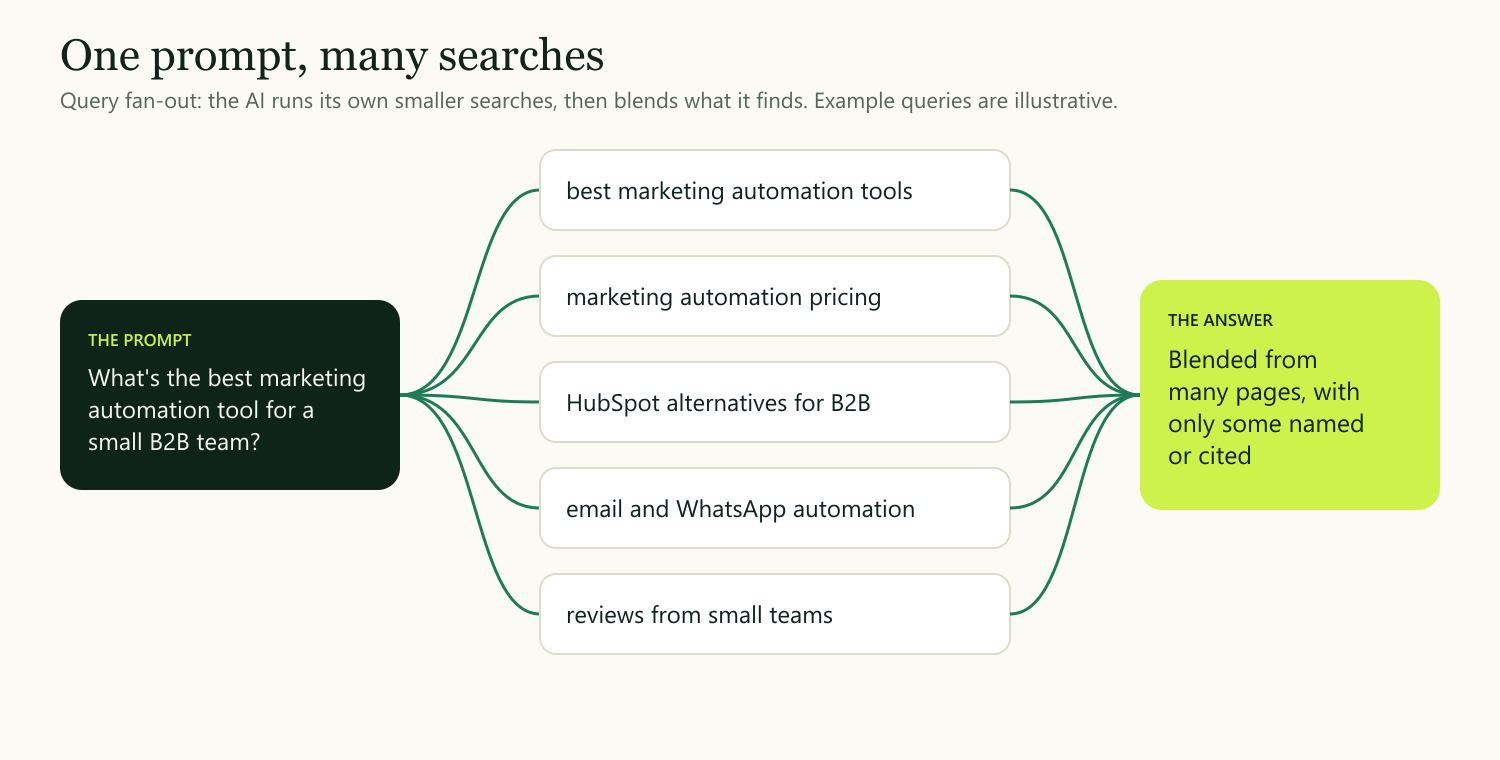
Don't go turning fan-outs into a keyword list, though. Ahrefs says over 95% have zero search volume, and the same prompt can fan out differently each time. Worse, Google warns that building separate pages for fan-out queries to manipulate results breaks its scaled content abuse policy. Use them as a window into what the AI thinks matters, then cover the topic properly on fewer, better pages.
Citations are also probabilistic. Ask the same thing five times and you might get cited three times. That's why we say "AI visibility" and not "AI rankings". Ahrefs points to three patterns that do hold up:
- Consensus: when several sources say the same thing about you, AI is more likely to repeat it.
- Freshness: AI-cited content is about 25.7% fresher than what ranks in organic results.
- Authority: 38% of AI Overview citations come from pages in Google's top 10.
Do ChatGPT, Perplexity and AI Overviews work the same way?
No, and it's not even close. Ahrefs found just 14% overlap in the top 50 most-cited domains across AI Overviews, ChatGPT and Perplexity. Only seven domains made all three lists. Even Google's two products barely agree: AI Overviews and AI Mode say similar things (86% semantic match) but share only 13.7% of their citations. When Semrush tested "best CRM tools", Perplexity cited listicles and Reddit, ChatGPT compared tools in tables without sources, and Gemini was the only one to leave HubSpot out of its top three.
| Platform | Tends to favor | Your best play |
|---|---|---|
| Google AI Overviews | Authoritative sites, YouTube, Reddit; 38% of citations from the top 10 | Rank well, then add YouTube and community presence |
| Google AI Mode | YouTube first, then Google and Wikipedia; more Quora and social | Video, plus real answers in communities |
| ChatGPT | High-authority publishers (median DR 90), Reddit, Wikipedia; only 8 to 10% overlap with Google's top 10 | Get mentioned on editorial sites and lists |
| Perplexity | Closest to Google: 28.6% of citations from the top 10 | Your existing SEO wins carry over fastest here |
If you can only pick two, Ahrefs says to start with Google and ChatGPT, since they carry most AI search traffic. And don't assume being named means getting a link. When Ahrefs tracked its own brand, only about 28% of AI mentions had one:
How often an AI mention of the brand included a link
- Perplexity51.6%
- AI Mode36.8%
- ChatGPT26.9%
- AI Overviews10.7%
So AI visibility comes in three flavors: cited with a link, mentioned without one, or not there at all. Unlinked mentions may work like word of mouth at scale, but be careful claiming they drive searches. Similarweb data cited by Kevin Indig suggests people visit recommended brands more in the following week, yet Indig's own 632 tests across four brands found no reliable link between AI visibility and later branded search or direct traffic. An effect may exist. Nobody's proved it cleanly yet.
Can smaller brands still win?
Yes, especially outside the head terms. Big names do dominate some spaces. BrightEdge's travel data shows American Airlines, Royal Caribbean and Expedia leading their categories on both AI Overviews and ChatGPT. But inspiration queries lean more toward Reddit, YouTube and first-hand voices.
Most categories are also still up for grabs. Kevin Indig's Growth Memo study, summarized by Seer Interactive, tracked 1,094 categories in ChatGPT and found about 54% have no clear leader, and those categories hold 89% of the demand. Ethan Smith also argued on Lenny's Podcast in September 2025 that AEO has a far longer tail than SEO, with ChatGPT questions running to 25+ words against about 6 in Google, and that new brands can show up fast through something like a good Reddit thread. Even Google says AI Mode queries are three times longer than traditional searches. Oddly specific questions are your opening.
Step 1: Can AI crawlers actually read your site?
Start here, because nothing else matters if the bots can't get in. Ahrefs says 5.89% of about 140 million sites block GPTBot. Plenty of them have no idea. It takes five minutes to check.
Pass Google's basic checks
Google's rule is simple: to appear in its AI features, a page must be indexed and eligible to show with a snippet. There's a newer check too. Your site must be included in Search generative AI features in Search Console, so look at that setting if you've never touched it. Then fix the boring stuff: crawl errors, duplicate content and page experience.
Sort your robots.txt
Each AI company runs separate bots for search and training, so you don't have to pick all-or-nothing. OpenAI says OAI-SearchBot decides whether you appear in ChatGPT search, while GPTBot is for model training. Block the first and you're ghosted in ChatGPT answers. Block the second and you've only opted out of training.
User-agent: OAI-SearchBot
Allow: /

User-agent: ChatGPT-User
Allow: /

User-agent: Claude-SearchBot
Allow: /

User-agent: PerplexityBot
Allow: /

# Training bots are a business decision:
# GPTBot, ClaudeBot, Google-Extended
One gotcha: Google-Extended is a control token for Gemini, not a crawler, and it doesn't affect Google Search or AI Overviews. Then check above robots.txt too. CDNs and firewalls can block AI bots by default, so look for 403s in your server logs.
Know the new AI controls
You now get more say over training versus answers, and that's changing fast. As of late October 2026, Microsoft announced separate Bing settings for AI training, AI grounding and limited grounding, and it starts honoring them on February 1, 2027. Google also plans to support a shared AI training preference in robots.txt in 2027, alongside other AI providers. Search Console already has an opt-out for Google's generative AI features too. My advice: don't touch that one unless you have a real reason, because you'd give up AI visibility and the test above suggests it could cost you regular clicks as well.
Put your content in the HTML
Google can process JavaScript as long as it isn't blocked, and Gemini and Copilot can render it. Ahrefs says ChatGPT's crawler can't. If your page builds itself in the browser, ChatGPT sees an empty shell. Test it: turn off JavaScript and reload. If your content vanishes, you need server-side rendering.
Fix speed, structure and fake URLs
- Speed: AI fetches pages on the fly, and a slow page can get dropped before it's even scored. At Piqual we cut page load times by 25%. That work now pays off twice.
- Structure: one H1, logical H2s and H3s, and sections that focus on one idea.
- Internal links: a page nothing links to is invisible in practice. Eli Schwartz suggests keeping important pages within three clicks of the homepage, and rendering those links on the server.
- Hallucinated URLs: AI assistants send people to 404s 2.87 times more often than Google. If a made-up URL keeps getting traffic, redirect it to the closest real page. Free clicks, basically.
Step 2: Where are your AI visibility gaps?
Run a brand gap analysis before you write a single word. It shows where you should be appearing versus where you actually are. First, list your entities: company name, products, proprietary features and metrics, and the people tied to your brand. Then connect each one to the topics it should own. Machines only know you by how you're described.
Next, sort what you find into the six brand gaps Ahrefs outlines:
- Visibility: competitors show up more often than you.
- Narrative: AI calls you the budget option when you're the premium one.
- Topic: you're missing from subjects you should own.
- Format: rivals have videos or comparisons getting cited, and you don't.
- Web mentions: lists, reviews and forums name them but not you.
- Demand: people search your space and your name never comes up.
Then pick one of three moves for each gap: fix what exists, build what's missing, or influence what others say. Go for quick wins first, like a ranking page that only needs a refresh. Not sure where you stand? My free AEO Readiness Score gives you a rough read in a couple of minutes.
Is AI telling your old story?
It might be, and that's called the LLM positioning lag. Semrush uses the term for when your positioning changes but AI hasn't caught up. Its examples are brutal. ChatGPT still treated Hotjar as a stand-alone tool more than a year after it merged into Contentsquare, and it still called Duolingo a language app despite math, music and chess launches. Blue Apron did a national TV and press push for pay-as-you-go, and ChatGPT still missed it.
So the fix isn't one press release. Announce the change clearly, update old content, align your site's language, refresh listings like LinkedIn, G2 and Crunchbase, and ask authoritative sites to correct stale descriptions. Semrush says it fixed its own "traditional SEO tool" label by changing how third-party pages described it, not by publishing more on its own site.
If you're not sure what's broken, Semrush's four layers make a good triage: can AI find you (discoverability), does it understand you (clarity), do you look qualified (authority), and will it confidently recommend you (trust)? Each failure needs a different fix, so don't default to "write more content".
Step 3: Which keywords and prompts should you chase?
Filter hard, because some keywords are traps now. Start with classic keyword research, then ask three things: would ranking help the business, does your page match the intent, and can you realistically compete? Then add the new filter: can AI satisfy this search on its own? If the AI Overview nails it, nobody's clicking. Google's People Also Ask box is a handy free source of the real questions worth answering.
Those keywords aren't dead. They just need a different goal:
- AI answers it fully? Stop chasing the click and aim for the mention. Look at the "best", "top", "vs", "review" and "alternative" queries where rivals appear and you don't.
- Needs a tool? Build one. AI can't replace a calculator, and searches like "mortgage calculator" show no AI Overview. It's why I put free SEO calculators on this site.
- Prompts? Don't chase one exact phrase. People phrase things 10 different ways and get 10 different answers, so aim to own the whole topic. Google says you don't need a page for every variation.
Revisit this often. Ahrefs says over 45% of citations change when AI Overviews refresh, which happens about every two days on average. This is a habit, not a one-and-done project.
Step 4: What content actually gets cited?
Fresh, specific, structured pages get cited, and length has nothing to do with it. Ahrefs studied 174,000+ cited pages and found a 0.04 correlation between word count and citations, which is basically zero. Over half (53.4%) were under 1,000 words. So stop padding. (Yes, I see the irony in a long checklist. It's long because it covers a lot, not because long works.)
Here's what does help, with no secret "AI format" needed:
- Lead with the answer. Put the question in a heading, answer it right away, then explain. Check out the bold lines in this article.
- Make sections stand alone. If AI lifts only one section, it should still make sense.
- Name things. "Ahrefs Keywords Explorer finds low-difficulty keywords" beats "this tool helps with SEO".
- Keep sentences simple. One idea per sentence. If it takes two reads, rewrite it.
- Brand your ideas. AI tends to absorb original concepts without credit, so put your name on them.
- Use formats AI can lift. Lists, comparisons and pages with original numbers. Ahrefs found 43.8% of cited pages were listicles.
- Show your receipts. The original GEO paper (KDD 2024) tested 10,000 queries. Citing sources, adding quotes and adding statistics lifted visibility by 30 to 40%, and clearer, more fluent writing helped too. Keyword stuffing did little and a more authoritative tone didn't help. Results varied by topic. Fifth-ranked sites gained up to 115%, while top-ranked sites lost ground when everyone optimized, so it may help challengers most. Just remember it used GPT-3.5 and top-five Google results back then, and stuffing in stats without real value won't last.
- Add images and video. Google says its AI features can pull them in, which means more ways to appear.
- Refresh "sleeper pages". Old pages with good backlinks and falling traffic are your fastest wins.
On freshness, 76% of ChatGPT's top-cited pages were refreshed within 30 days. An AirOps study cited by Semrush found 95% of ChatGPT citations came from content published or updated in the last 10 months, and pages with a clear "last updated" date earned 1.8x more citations. So show the date, and use dateModified in your schema. But don't just change the date and call it a day. That's lazy and it's obvious. Add new stats, new examples and new thinking.
A page that says what ten other pages already say gives AI no reason to pick yours.
That's what Google means by non-commodity content, and it says this will likely influence your AI search presence more than anything else in its guide. "7 Tips for First-Time Homebuyers" is commodity. A first-hand story about what you actually did and what it cost you isn't. Your data, your tests and your opinions are what a generic assistant can't produce.
Semrush has a nice real-world example. Its March 2025 AI Overviews study spread through Reddit and newsletters, earned over 1,900 links, and then started showing up in ChatGPT's answers. Original data travels. That's the whole game.
Step 5: How do you earn brand mentions?
Earn them on the pages AI already reads, because mentions are the strongest signal we can see. In Ahrefs' study of 75,000 brands, web mentions beat every classic SEO metric:
Correlation with brand visibility in AI Overviews
- Brand web mentions0.664
- Brand anchors0.527
- Brand search volume0.392
- Domain Rating0.326
- Referring domains0.295
- Organic traffic0.274
- Backlinks0.218
Where you're mentioned matters too. Mentions on highly linked pages hit a 0.7 correlation. It helps to think about your sources in three tiers:
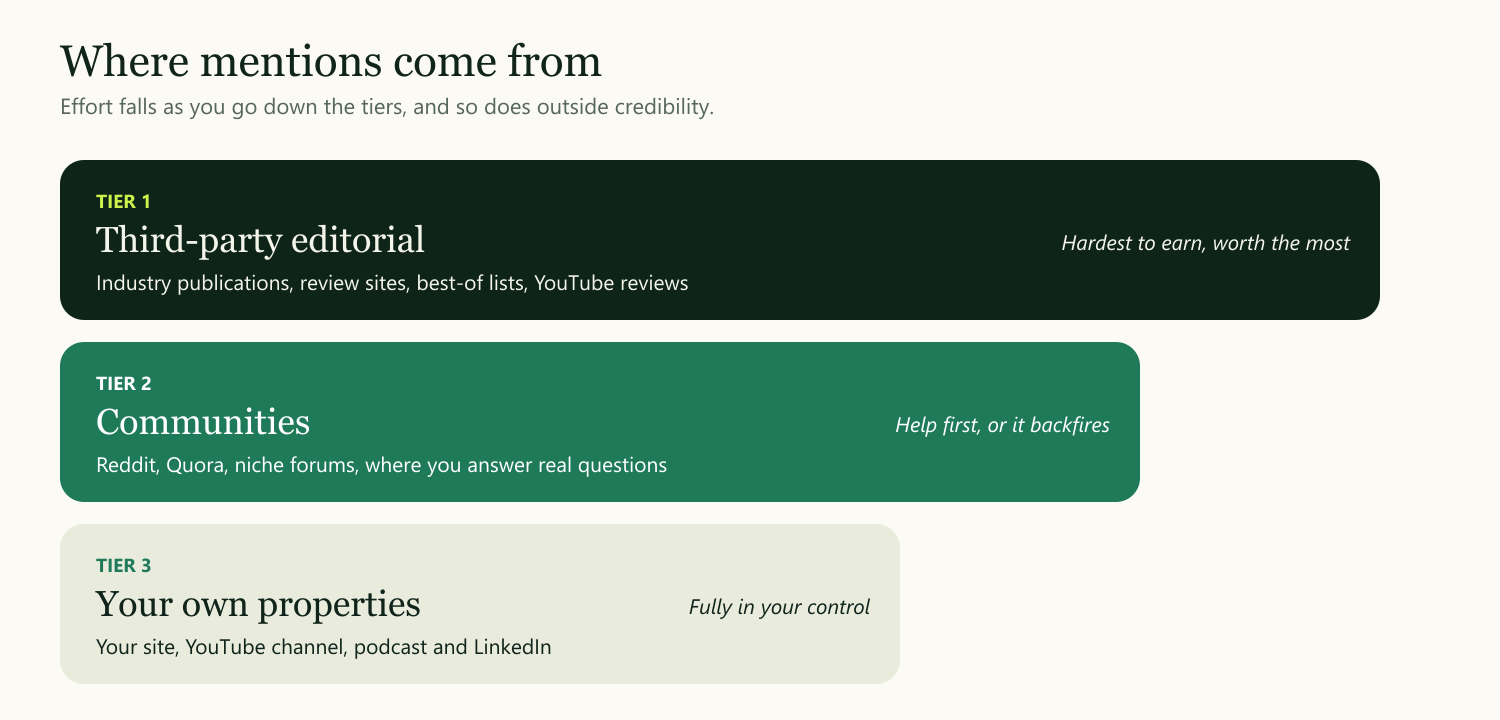
Consistency matters as much as volume. Semrush points out that LLMs also learn who you are from places like Wikidata, Crunchbase and LinkedIn, so make sure your brand details match everywhere. And don't overlook unlinked mentions, which may carry real weight in AI visibility even with no link attached.
Please don't try to game this. No fake reviews, no astroturfing Reddit. Google says seeking inauthentic mentions isn't as helpful as it might seem, and on Reddit you'll get roasted anyway. Find threads where you can genuinely help, then help.
Also audit what's out there. Mentions vanish when lists get updated, and bad info spreads fast. Ahrefs' fake-brand experiment planted contradicting stories online, and Gemini and Perplexity repeated the misinformation in 37 to 39% of answers. ChatGPT stayed under 7%, citing the brand's official FAQ in 84% of answers. The fix is boring and it works: publish clear official facts about your brand before someone else fills the gap. Rand Fishkin makes the same case for keeping your website as home base. SparkToro rebuilt its help hub after noticing AI answers about its product were wrong because they drew on old information.
A word on Reddit, since everyone's asking. Ethan Smith's advice is simple: use one real account, say who you are and where you work, and give genuinely helpful answers. Just don't build your plan on it. Semrush saw ChatGPT's Reddit citations fall from close to 60% of responses to around 10% within weeks in 2025 before settling again. Eli Schwartz puts it well: be on Reddit because it's a community, not because of AEO.
Step 6: Why does YouTube matter so much for AI?
YouTube is the most-cited domain in AI Overviews, and it's also what AI learns from. Ahrefs reports a 0.737 correlation between YouTube mentions and ChatGPT visibility, the strongest of any factor it studied. Go for search hits, not viral hits:
- Find videos already ranking in Google for your topics.
- Put the keyword in the title. Save the creativity for the thumbnail.
- Write a real description, add timestamps, and say the keyword out loud.
- Match the format that's already winning, whether that's a tutorial or a list.
There's a November 2026 bonus here. In Ahrefs' panel of 100 brands, Wikipedia, YouTube and LinkedIn were the top external sources in branded AI Overviews. So those channels now shape what people read about you on your own brand search. Keep them accurate and active.
Step 7: Does schema help you get cited?
Probably not directly, but keep it anyway. Ahrefs says there's no confirmed data that schema improves AI citations, and Google says no special markup is needed for generative AI search. It still helps with rich results and with making clear who you are. Use Article, Person, Organization, Product and BreadcrumbList where they're true, and never mark up things that aren't on the page. A real author with a real bio does more for trust than any tag.
What about local, ecommerce and AI agents?
If you sell things or serve a location, keep your business data spotless. Google says AI responses can include product listings and local business details, so keep your Merchant Center feeds and Google Business Profile accurate.
AI agents are the next layer, and answer-ready isn't agent-ready. A page can be easy to cite and still fail when an agent tries to use it. Browser agents can read screenshots, the DOM and the accessibility tree to book or compare things for people, so real buttons, proper labels and clear pricing now pull double duty. Semrush also notes there's no published evidence that files like llms.txt or agent cards increase citations. Google also points to protocols like Universal Commerce Protocol (UCP). Worth watching, but only if you've got spare time after everything above. Some SEOs, like this Moz Whiteboard Friday, argue for serving agents Markdown because it uses fewer tokens. Google says Search doesn't need it, so treat that as an experiment for agent use cases, not a ranking play.
Step 8: How do you measure AI visibility?
Use several imperfect signals, because no single report tells the whole story. This has improved a lot in 2026:
- Search Console: Google's Generative AI performance reports launched in June 2026 and reached all sites by August 31. They show impressions by page, country, device and date.
- Bing Webmaster Tools: the AI Performance report shows citations in Copilot and Bing's AI summaries, plus the grounding queries behind them.
- Prompt tracking: ChatGPT, Claude and Perplexity offer nothing similar yet, so track a fixed set of buyer questions. Semrush suggests starting with 20 to 25, and Eli Schwartz says dozens usually cover it, so skip the tools pushing thousands. Pull them from sales calls and support tickets, and run your top ones several times, since one run proves nothing.
- Bot activity: pages that citation bots keep hitting are likely being used as sources.
- Branded search: watch branded queries in Search Console as a brand health signal, not as proof that AI caused them.
Third-party AI visibility tools are useful for your workflow, but stay skeptical. Google says no third-party tool has access to its internal ranking or AI systems, so be wary of anyone promising ranking success.
For referral traffic, add an AI channel in GA4 under Admin, Data display, Channel groups. Older guides only list the previous ChatGPT domain, so I'd include both:
chatgpt\.com|chat\.openai\.com|perplexity|gemini\.google\.com|copilot\.microsoft\.com|claude\.ai|deepseek\.comThat number will always undercount. Some AI tools strip referral data, and desktop apps often pass none. Don't assume your Direct traffic is hidden AI, though. When Kevin Indig went hunting across 12 sites, much of the growth was bots: one site logged 409,000 Direct sessions and only 198 engaged ones. So ask humans. A simple "How did you hear about us?" field with ChatGPT and AI search as options catches what analytics can't. Ramp used that kind of self-reported data to confirm AI behind 30 to 40% of its direct traffic.
No single number will prove this, so report three layers together: exposure (mentions and share of voice), behavior (branded search, self-reported discovery) and business results (pipeline and revenue). Confidence rises when they move together. When they split, you know where to dig.
Visible isn't the same as recommended
A mention only counts if it's a good one. Seer Interactive calls this the anti-recommendation: ChatGPT telling people to look beyond Airbnb and VRBO, for example. Both brands are visible, and neither is recommended. A share-of-voice report would call that a win. Seer also had a decking brand that dominated AI answers, yet in 35% of those responses a competitor got the "best overall" label.
Citations and mentions aren't the same thing either. In Semrush's study of 3,981 brand appearances, 62% were citations where the answer never named the brand. ChatGPT cited brands in 87% of appearances but named them in just 20.7%. And being top of the list really counts: Growth Memo's AI Mode research found 88% of participants took the shortlist as given and 74% picked the top-ranked product, though a brand they recognized could beat rank one.
So write a "brand canon": a living doc of the claims, positioning and facts AI should get right. Then Seer's three KPIs are worth stealing:
- Be seen: how often you're mentioned in your category.
- Be believed: how accurately AI represents you.
- Be chosen: how well AI-influenced visitors convert.
Which one matters depends on your category. If it's wide open, chase visibility. If there's a clear owner, like Airbnb for vacation rentals, stop fighting that battle and focus on accuracy and beating your real rivals.
What AEO advice can you safely skip?
Skip anything that promises a shortcut. Google addressed most of these directly in its myth-busting section, last updated in July 2026.
| The tactic | The reality |
|---|---|
| llms.txt as a ranking boost | Google ignores it, and no major LLM provider officially supports it. Harmless, but no magic. |
| Chopping content into tiny chunks | Not required, says Google. Stand-alone sections are about clear writing, not fragments. |
| Rewriting everything for AI | Google says you don't need to. Write for people. |
| A separate page for every prompt or fan-out query | Google says doing this to manipulate results breaks its scaled content policy. |
| Special AI schema | Doesn't exist. |
| Long articles for the sake of length | Word count shows almost no correlation with citations. |
| Buying mentions and fake reviews | Spam systems apply here too. Hard pass. |
"Google Search ignores them."
Full disclosure: this site has an llms.txt. It took minutes, and I expect exactly zero Google benefit from it. That's the right mindset for this one.
Your 90-day AEO plan
Fix access first, then content, then authority. The order matters more than the speed.
| When | Focus | Do this |
|---|---|---|
| Week 1 | Quick checks | Check robots.txt and JavaScript rendering, set up the GA4 channel, add "How did you hear about us?" |
| Days 8 to 30 | Baseline and refresh | Run your gap analysis, pick 20 to 50 prompts, and meaningfully update your top 5 to 10 pages |
| Days 31 to 60 | Original work | Publish what only you can: data, tests, comparisons, a free tool. Add real author bios |
| Days 61 to 90 | Authority | Go after your top 10 mention targets, start your YouTube search hits, review your numbers |
| Ongoing | Keep it alive | Monthly visibility check, quarterly competitor audit |
The full AEO checklist
Tick these off as you go. Your ticks clear when you reload, so print it if you want to keep score.
Frequently asked questions
What is AEO?
AEO, or Answer Engine Optimization, is the work of getting your brand named or cited when people ask AI tools like ChatGPT, Perplexity, Gemini, Copilot or Google's AI Overviews a question. It builds on SEO rather than replacing it.
Is AEO the same as GEO?
In practice, yes. AEO and GEO (Generative Engine Optimization) describe the same job, and Google treats both as SEO. Build one strategy, not two.
Do I need llms.txt to get cited by AI?
No. Google says Google Search ignores llms.txt, and Ahrefs reports that 97% of the llms.txt files it studied across 137,000 sites never got read. It's harmless and takes minutes to add, but it shouldn't be on your priority list.
Should I block GPTBot?
That's a business decision, separate from AI search. GPTBot collects content for model training, while OAI-SearchBot controls whether you appear in ChatGPT search. You can block one and allow the other.
Is GEO a distraction?
As a traffic play, it can be. Marie Haynes found ChatGPT sent just 0.62% of Google organic's sessions across 100 sites. But AI can shape which brands buyers shortlist, so treat it like a brand channel, keep Google as your priority, and don't let it replace your SEO work.
Should I opt out of Google's AI features?
Usually not. Search Console offers an opt-out, but you lose AI visibility, and a small October 2026 test by Cyrus Shepard saw regular organic clicks fall too. Only opt out if you have a clear business reason.
Does schema markup help you get cited by AI?
There's no confirmed evidence that it does. Google says structured data isn't required for generative AI search. Keep it because it helps with rich results and clarity, and make sure it matches what's visible on the page.
How long does AEO take to work?
Technical fixes can land quickly, because a refreshed page can be picked up on the next crawl. Brand mentions take months to build up. Review a fixed prompt list monthly and judge the trend over at least a quarter, because AI answers change from one run to the next.
How do I track AI citations?
Use Search Console's Generative AI performance report for Google, Bing's AI Performance report for Copilot, and a fixed prompt list for ChatGPT, Claude and Perplexity. Add an AI channel in GA4, and ask buyers how they heard about you.
About the author
Nayana B. Sen
Nayana is an SEO Manager at Visme, a visual content platform with 38M+ users, with nearly 10 years of SEO experience across the US, Canada and the UK. An engineer turned SEO leader, she has built and led teams of up to 35 and tracks AI search visibility across ChatGPT, AI Overviews, Gemini, Perplexity and Copilot.
Sources and further reading
Figures come from the sources below and were checked in November 2026. Many are correlations or single-company data, so test them against your own numbers.
- Google Search Central: Optimizing your website for generative AI features
- Google Search Central: Search Generative AI performance reports (June 2026)
- OpenAI: Overview of OpenAI crawlers
- Semrush: Generative Engine Optimization, A Practical Guide
- Semrush: What Is Answer Engine Optimization?
- Semrush: GEO vs. SEO, A Comparative Guide
- Ahrefs: AI Overviews Currently Appear for 83% of Branded Searches (October 2026)
- Ahrefs: An Analysis of AI Overview Brand Visibility Factors (75K Brands)
- Ahrefs: Top Brand Visibility Factors in ChatGPT, AI Mode and AI Overviews
- Ahrefs: Do AI Assistants Link When Mentioning Brands?
- Ahrefs: AI Overviews Reduce Clicks by 58%
- Ahrefs: What Triggers AI Overviews?
- Ahrefs: AI Traffic Has Increased 9.7x in the Past Year
- Ahrefs: Does AI Search Traffic Convert Better Than Traditional Search?
- Ahrefs: What is Query Fan-Out?
- Ahrefs: AI Assistants Prefer to Cite Fresher Content
- Ahrefs: 38% of AI Overview Citations Pull From the Top 10
- Ahrefs: 86% of Top Mentioned Sources Are Not Shared Across AI Assistants
- Ahrefs: Are AI Mode and AI Overviews Just Different Versions of the Same Answer?
- Ahrefs: The AI Bots That ~140 Million Websites Block the Most
- Ahrefs: How Often Do AI Assistants Hallucinate Links?
- Ahrefs: Brand Gap Analysis
- Ahrefs: AI Overviews Change Every 2 Days
- Ahrefs: Short vs. Long Content in AI Overviews
- Ahrefs: Do Self-Promotional Best Lists Boost ChatGPT Visibility?
- Ahrefs: AI Misinformation Experiment
- Ahrefs: AI Assistants Are Breaking Web Analytics
- Ahrefs: We Analyzed 137K Sites, 97% of llms.txt Files Never Get Read
- Aggarwal et al.: GEO, Generative Engine Optimization (KDD 2024)
- Graphite: The Ultimate Guide to AEO on Lenny's Podcast
- Semrush: The LLM Positioning Lag
- Semrush: AI Search Strategy, 4 Layers of Brand Visibility
- Seer Interactive: Re-imagining AI Visibility KPIs
- Seer Interactive: AI Visibility Is Lying to You
- Search Engine Roundtable: AI Overviews and AI Mode Opt-Out Study
- Search Engine Roundtable: Microsoft Bing's New AI Controls
- Search Engine Roundtable: Google Adopts New AI Training Control
- Search Engine Journal: Big Brands Dominate AI Search But Leave Openings
- Search Engine Journal: How AI Search Is Reshaping What Users Query
- Moz: The SEO's Guide to Agentic Commerce, Whiteboard Friday
- Marie Haynes: GEO Is a Distraction
- SparkToro: Is AI Visibility a Marketing Boondoggle?
- SparkToro: Does Your Website Still Matter in the Zero-Click Era?
- Growth Memo: Organic Traffic Is Down, but It's Not All AI
- Growth Memo: Does AI Drive More Direct Traffic?
- Growth Memo: Shopping Is Part of the Product
- Growth Memo: How to Plan 2027 When Traffic Is Down
- Eli Schwartz: Build an SEO Competitor Dashboard
- Eli Schwartz: The Easiest SEO Links You Can Get
- Eli Schwartz: Reddit Should Stop Feeding Google
- BacklinkBees: The Complete AEO Checklist
- Previsible: Bing Added AI Performance Report